By MarriageBiodata.App English Editorial TeamPublished
How to write a Sunni Muslim marriage biodata
Your Sunni marriage biodata should introduce you clearly enough to start a conversation. Put your name, current city, education and work, brief family context, and one approved contact first. Add a Sunni identity or practice note only if you want to share it. You can discuss the finer points of faith and marriage arrangements later.
This guide builds on the general Muslim marriage biodata guide and focuses on details you may find useful in a Sunni introduction.
What to include in your Sunni marriage biodata
- Personal details: Add your preferred name, date of birth or age, current city, height and marital status. Add your mother tongue or hometown if useful. Include a recent photo only if you are comfortable sharing it.
- Education and work: State your highest qualification, current role or field, and work city. Add your plans for work after marriage if they matter to you.
- Family: Introduce your parents or guardians and siblings in a line or two. Add family origin or a brief household description only with their agreement.
- Sunni identity: Write “Sunni Muslim” if you want that stated. You can also include a madhhab, a South Asian affiliation or a meaningful practice note when the wording is accurate and useful to you.
- Preferences: Give a few specific expectations about values, location or life plans. Mention relocation or work preferences if they will shape your decision.
- Reply: Choose one person who expects enquiries and share an approved phone number or email. Add a convenient time to call if helpful.
Keep your first page easy to scan. If your family helps prepare it, agree together on the photo, faith description, family details and contact before sharing.
What to ask your family about Sunni details
Start with the words you use for your own identity. Your family can help check terms, but you should agree on what appears in your biodata.
- “Sunni Muslim”: Ask whether this is enough for your introduction. If it is, write it plainly and leave further questions for a conversation.
- Madhhab: Ask whether a school of jurisprudence matters to you or your family. If you use a label such as Hanafi, Shafi'i, Maliki or Hanbali, add it accurately. A madhhab is not a measure of how observant you are; you need not claim one if you do not use it.
- South Asian affiliation: Ask whether you identify as Deobandi, Barelvi or Ahl-i Hadith and whether sharing that helps explain an important preference. These terms are not interchangeable with the four madhhabs. You may, for example, use both Hanafi and Deobandi if both describe you.
- Practice note: Ask which part of your daily life you would want someone to know. If it feels useful, write a short note such as “observes Ramadan fasting” or “would like to discuss religious routines together.” Avoid turning your biodata into a list of prayer counts or claims about your whole family.
- Private conversation: Decide which questions need a respectful discussion instead. You can talk about religious compatibility, mahr and nikah expectations directly with the people involved.
Use only descriptions you choose and have checked. Do not infer an affiliation from a surname, clothing, language or birthplace.
Anatomy of a Sunni Muslim Marriage Biodata that gets a Response
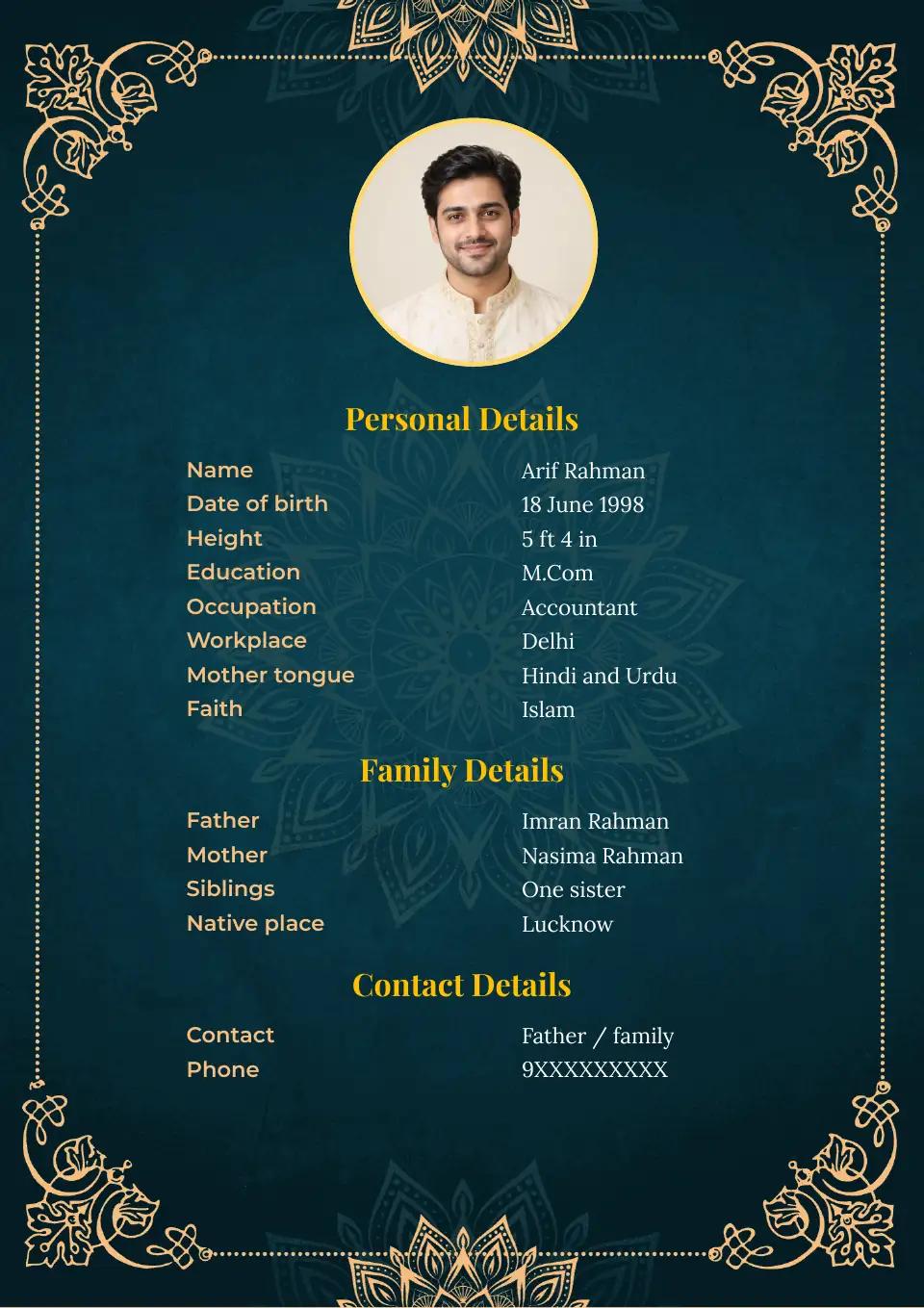
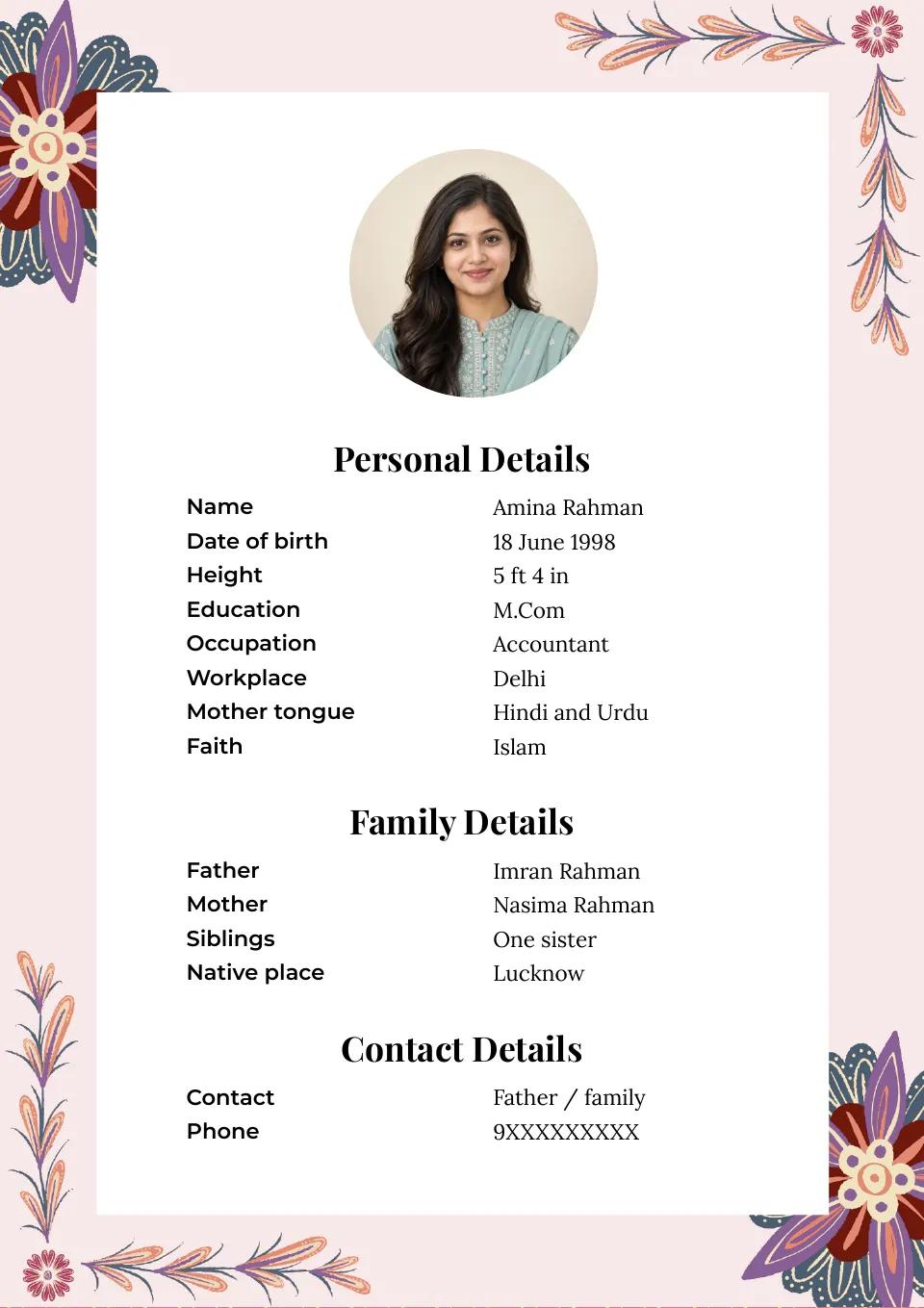
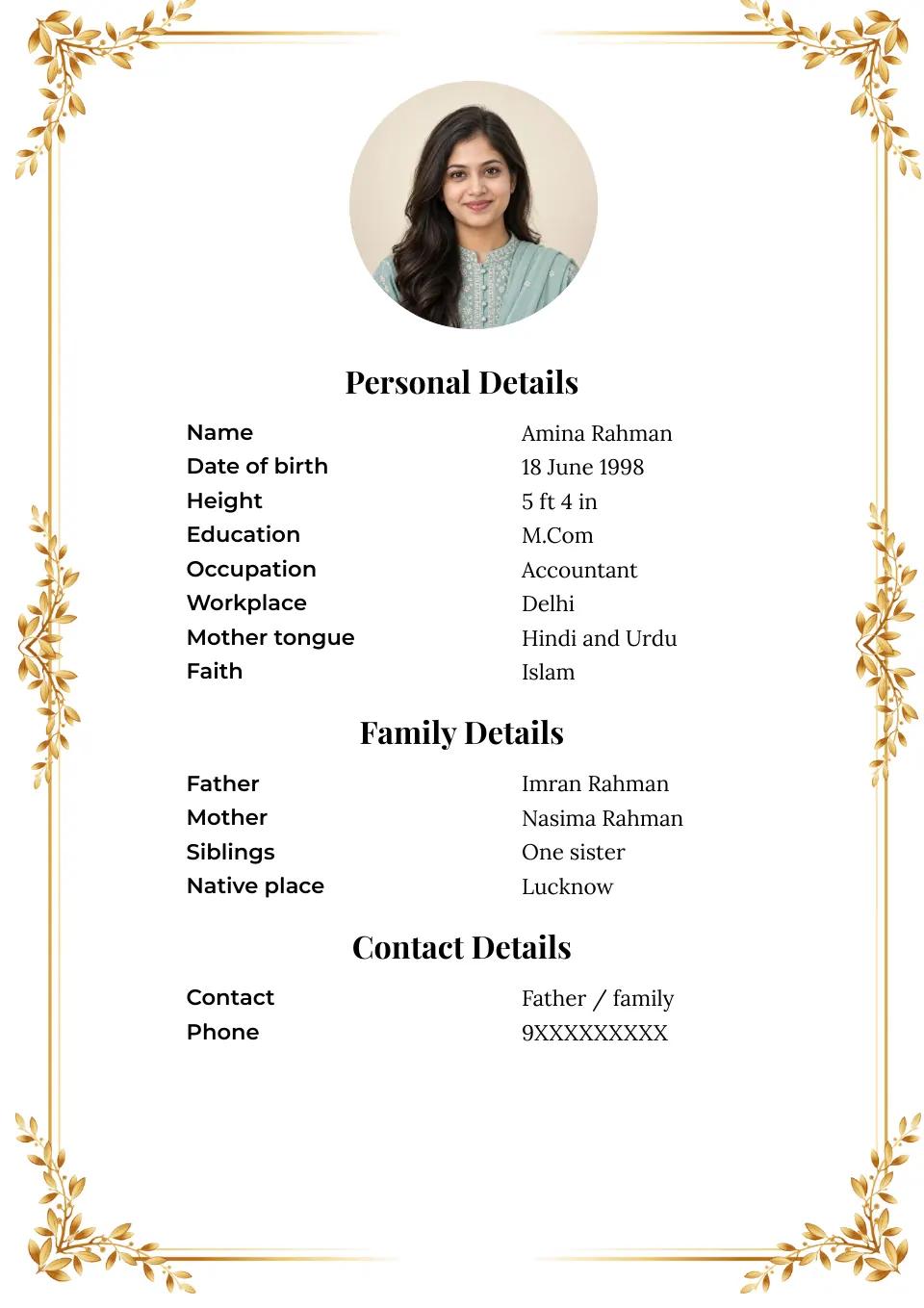
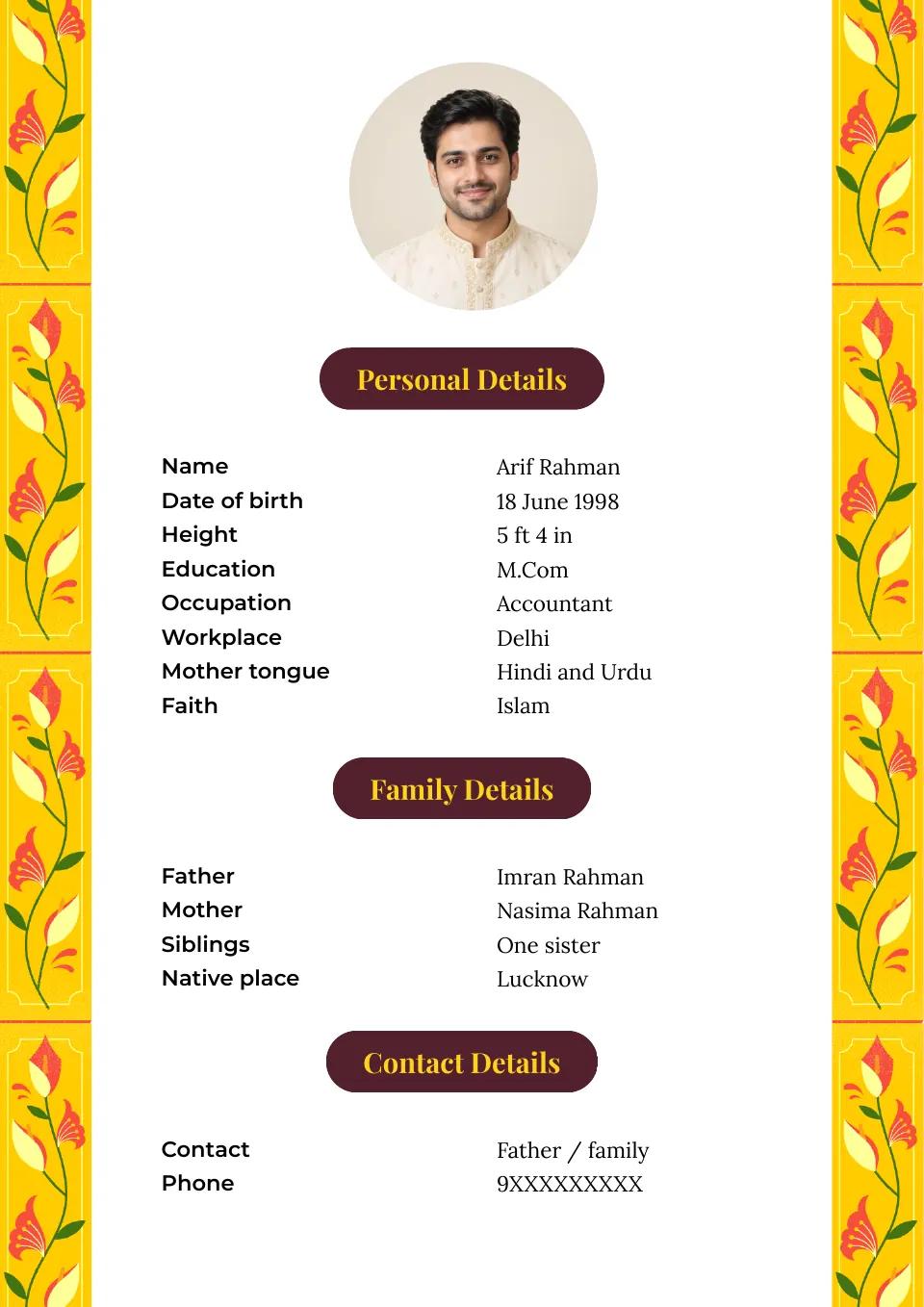
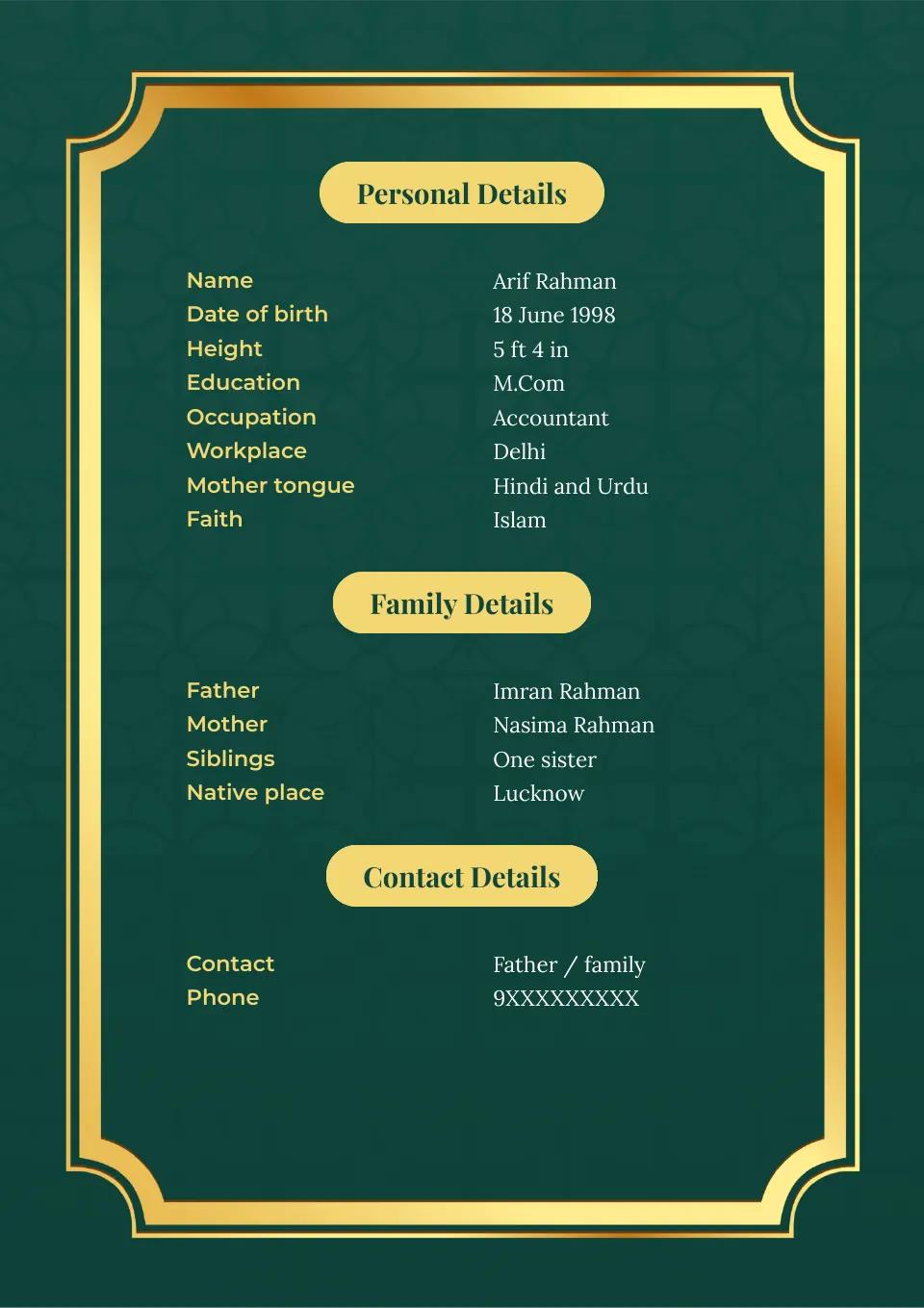
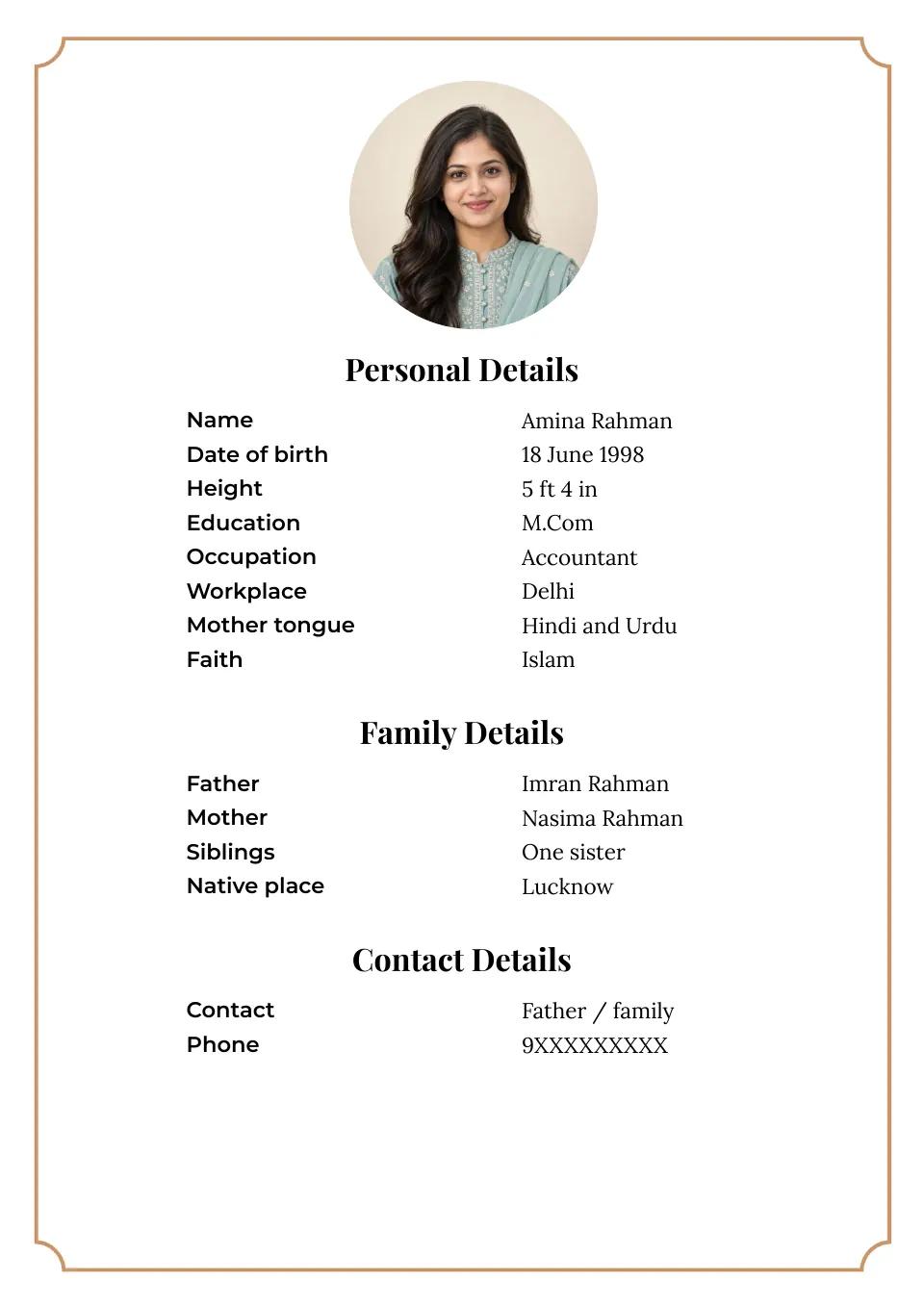
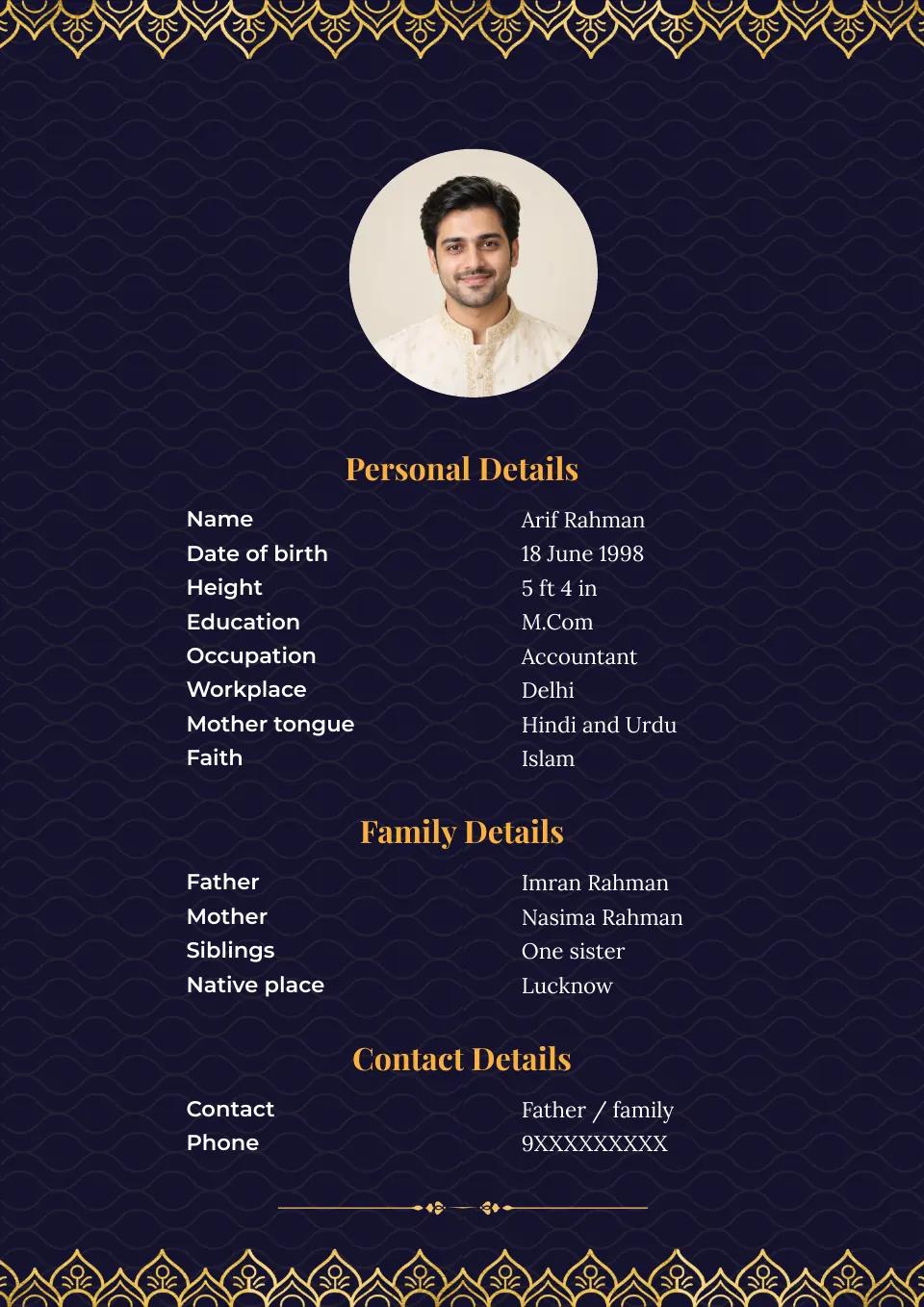
The example below is fictional. It shows how you might arrange a Kolkata-based profile that voluntarily shares “Sunni, Hanafi.” That pairing is an example, not a required format. The phone number is masked.
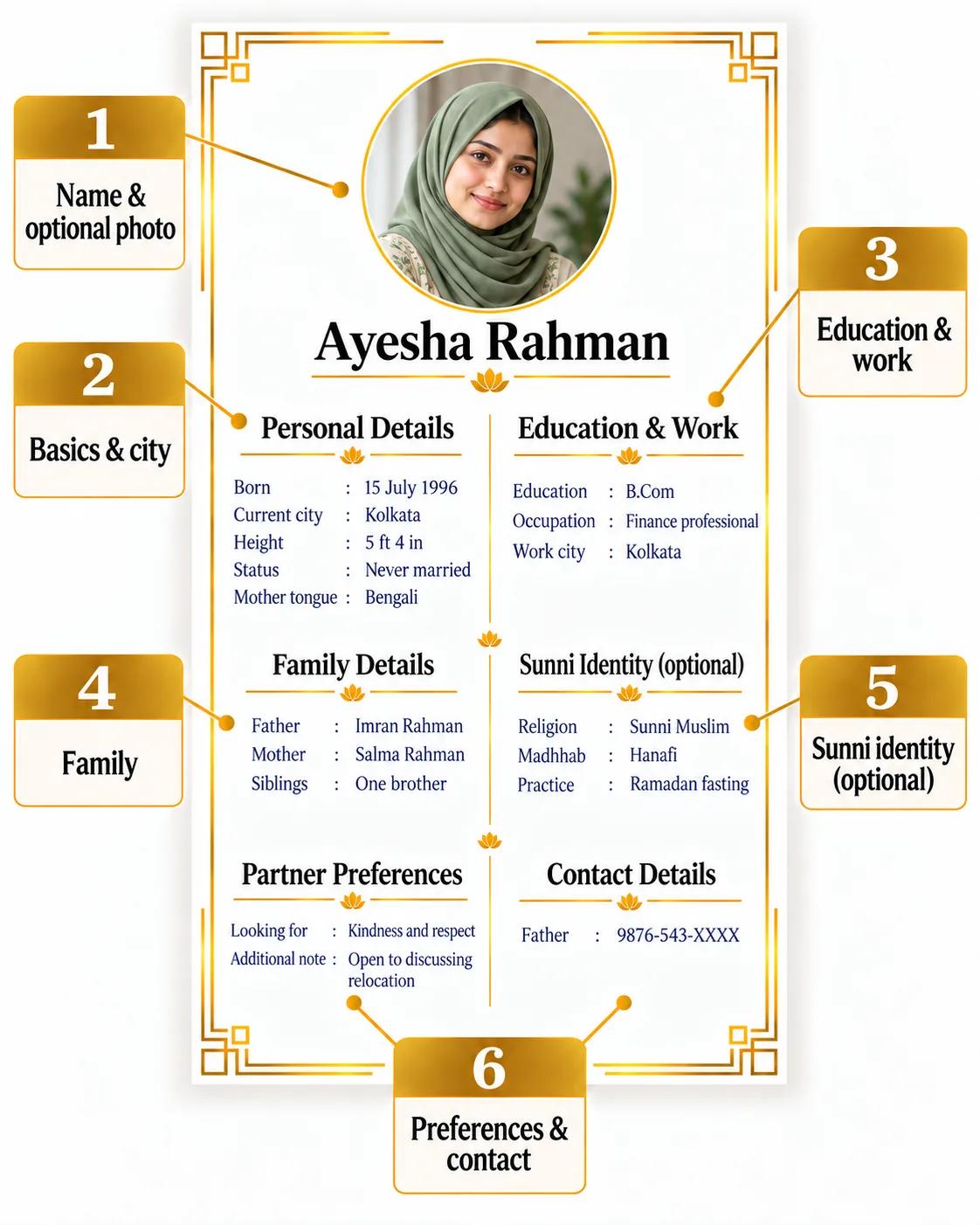
1. Lead with your name and optional photo
Put your preferred name at the top. A clear, recent photo can help start a conversation if you are comfortable sharing one. It is not proof of faith or a requirement for your first introduction.
2. Give your basics and city
Use an accurate birth date or age, current city, height and marital status. Your mother tongue can help families plan a first conversation. A city is usually enough; leave your street address and identity documents off a widely forwarded PDF.
3. Summarize your education and work
List your highest qualification, current occupation and work city. If continuing a job, studying further or relocating matters to you, add one plain sentence.
4. Add family context with consent
Introduce your parents or guardians and siblings briefly. Agree on what you share about them. Leave out relatives' phone numbers, salaries, property and any detail they have not agreed to share.
5. Describe your Sunni identity in your own words
The fictional profile says “Sunni, Hanafi” and includes a simple practice note. You may prefer just “Sunni” or no public faith detail. If a Deobandi, Barelvi or Ahl-i Hadith affiliation matters to you, state it accurately rather than using it as a synonym for madhhab.
6. Close with preferences and one contact
Write a few positive, specific preferences and one approved contact. “Open to discussing relocation” is easier to respond to than a long list of demands. Discuss mahr, wedding arrangements and other contract questions directly with the people involved.
Common mistakes to avoid
- Turning your Sunni identity into a questionnaire. Share meaningful details voluntarily; you do not need a public inventory of your practice.
- Mixing up madhhab and South Asian affiliation. Check each term you use rather than guessing from a name.
- Using a broad label that does not reflect your own words. Agree with your family on how you want to describe your identity.
- Copying a template without checking it. Remove fields that do not apply to you, including astrology or kundli fields if they are irrelevant.
- Oversharing private information. Leave your full address, identification numbers, unapproved personal contact and financial documents for later trusted conversations.
- Publishing rigid or demeaning preferences. Focus on your values, plans and practical compatibility instead of appearance, status or dowry demands.
Before you share the PDF
- Check your preferred name spelling, current city, education and work.
- Check your family details and agree on what you will share.
- Write your Sunni identity in your own words and verify any optional terms.
- Attach a recent, clear photo if you are comfortable sharing one.
- Choose one approved contact who expects enquiries.
- Remove your full address, identity numbers and other private details.
- Open the PDF on a phone and check the layout, dates and contact details.
One page is usually enough for an introduction. You can discuss the details that matter to you in the next conversation.
Frequently asked questions
Should I add a photo to my Sunni Muslim marriage biodata?
A photo is optional. If you are comfortable sharing one, a recent, clear photo can improve the chance of a positive first conversation. Agree on it with your family if they are helping prepare your biodata.
Should I mention my madhhab or Sunni affiliation?
Share a label only if you use it and want others to know it. “Sunni Muslim” may be enough. If you add a madhhab or South Asian affiliation, check the wording and keep the terms distinct.
What contact details should I share in my first PDF?
Give your city and one approved contact who expects replies. Keep your full address, identity numbers and financial documents for later trusted conversations.
Should I write mahr or nikah expectations in my biodata?
You can leave detailed mahr, nikah and wedding arrangements for a direct conversation with the people involved. If an expectation is important to you from the start, keep your wording brief and agree on it before sharing.
You can create a Muslim marriage biodata and choose a format that keeps your information clear. If you are comparing branch-specific wording, the Shia biodata guide explains why Shia traditions call for different labels and optional details.
For the terminology used above, see Egypt's Dar Al-Ifta on Sunni legal schools and Cambridge research on South Asian Sunni affiliations.